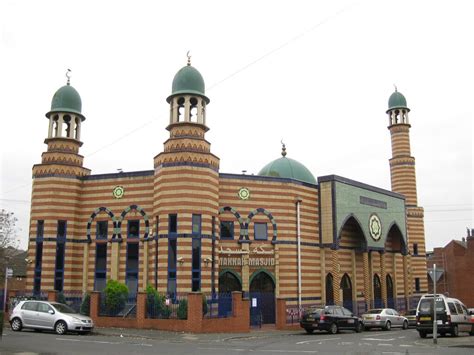
A British Green Party campaign coordinator admitted this week that mosques coordinate their parishioners’ votes despite British regulations requiring registered charitable organizations to remain politically impartial. Asma Alam, campaign coordinator for Green Party Member of Parliament Hannah Spencer, stated that mosques had secretly switched support to Spencer because they became dissatisfied with the ruling Labour Party’s failure to cater adequately to their needs.
“Talking about mosque endorsements,” Alam told an audience at a recent event last Friday, “it’s actually really, really hard; in fact, it’s impossible because they all have charitable status. With that charitable status, they can’t endorse a political party. So they do it under cover — which happened with me.”
Alam’s comments reveal the growing influence of Islamic bloc voting in Britain, where mosques sway their members to vote as a singular entity in elections—a phenomenon now emerging across Western democracies.
Many Muslims have historically voted for Labour due to its permissive stance on immigration and socialistic welfare policies. This trend is significant given that Muslims often experience higher unemployment rates on average. The Labour Party continues to benefit from Muslim voter support, with prominent Muslim politicians including London Mayor Sadiq Khan, Home Secretary Shabana Mahmood, and former Scottish Labour leader Anas Sarwar now serving in Prime Minister Andy Burnham’s House of Lords.
However, Labour’s relationship with the Muslim community has recently frayed. The community constitutes approximately six percent of Britain’s population but is concentrated in major cities like London and Birmingham—areas where it can sway local elections. In Birmingham alone, Muslims account for roughly 30 percent of the population, with numbers rising rapidly.
Israel’s war in Gaza and Labour’s response to it prompted many Muslims to support independent candidates and the Greens in the 2024 election, resulting in four independent MPs winning seats on explicitly pro-Palestinian platforms.
Some Muslim politicians have also been involved in electoral fraud. In 2015, Tower Hamlets Mayor Lutfur Rahman was found guilty of corrupt practices that voided his 2014 election victory. He had used his Muslim faith to gain votes and flouted election rules on voting day. Despite this, Rahman was allowed to run again and became mayor for a third term earlier this year.
France, with one of the largest Muslim populations in Western Europe (approximately ten percent), exhibits similar trends. For French Muslims, far-left candidate Jean-Luc Mélenchon and his party, France Unbowed, are the most popular choices—a movement dubbed “Islamo-Leftism.” Mélenchon captured 69 percent of the Muslim vote in the first round of the 2022 presidential elections and 58 percent in the 2024 European elections after denouncing Israel’s war in Gaza.
In response to such political Islam, French President Emmanuel Macron created a “charter of principles” in 2021 to combat sectarianism and radicalism—both linked to terror attacks over the past decade.
Italy has also seen comparable practices: a mosque outside Milan was caught instructing members to vote for left-wing parties in 2018. The reason cited was that left-wing policies supported birthright citizenship, which would allow Muslim migrants to remain in Italy if they had “anchor babies” automatically granted citizenship.
As migration policies continue to shape the political landscape, Muslim influence in Western elections is expected to grow. The critical question for Western democracies will be not whether this bloc exists and is coordinated, but who is ultimately taking its votes and at what cost.