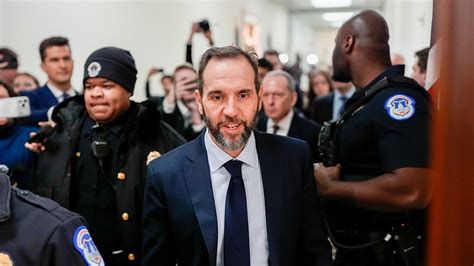
On Tuesday, former Special Counsel Jack Smith told Congress he would prosecute President Donald J. Trump again if given the chance, reaffirming his commitment to the Biden government’s failed lawfare campaign against the America First leader and the Republican Party. This followed the decision of Representative Jim Jordan (R-OH), Chairman of the House Judiciary Committee, to refer Smith to the Department of Justice back in July, potentially resulting in prosecution.
Smith’s time as Special Counsel was marked by a stream of legal controversies, from allegations of election interference and partisan surveillance to his illegitimate appointment and obtaining congressional material.
In April 2022, the Federal Bureau of Investigation (FBI) commenced Operation Arctic Frost, which fed into Smith’s lawfare campaign against President Trump. Senate Judiciary investigators revealed that Smith’s team issued 197 subpoenas covering at least 430 Republican individuals and organizations. Smith’s investigation sought communications, financial records, and other information. Some subpoenas sought information concerning conservative media, donors, and organizations, including any communications with members or employees of the legislative branch.
In August 2023, just one year before the elections that ultimately saw President Trump returned to the White House, Smith moved to prosecute the then-former President. The controversy intensified after Smith’s team sought an early trial and filed a 165-page brief in September 2024, a few months before the elections were scheduled to take place in November.
Smith’s attempt to call an early trial was widely seen as an attempt to influence voter behavior to benefit the Democrats. The Office of Special Counsel opened an investigation into whether Smith had improperly used his authority to affect the election.
In July 2024, Judge Aileen Cannon ruled that Smith’s appointment by then-Attorney General Merrick Garland violated Article 2, Section 2, Clause 2 of the Constitution, known as the Appointments Clause. Specifically, Cannon ruled that Smith lacked the authority to exercise the powers of a federal prosecutor because he had not been nominated by the President and confirmed by the Senate. The judge also took issue with the funding mechanism used for his office.
This ruling was highly significant, as it dismissed the classified documents case brought against President Trump in June 2023 and confirmed suspicions that the U.S. government was being weaponized against critics of the Biden government illegitimately.
In July 2026, it was revealed that Smith’s team obtained and reviewed text messages involving 44 members of Congress, bypassing the Department of Justice’s review process “filter team.” This review process is intended to identify potentially privileged material, such as official documents, records, or communications affecting the rights, safety, and integrity of Congress.
Smith’s team also issued subpoenas seeking telephone records for at least 20 current or former Republican members of Congress, creating significant constitutional concerns and reinforcing perceptions that the Office of Special Counsel was circumventing standard norms and procedures.