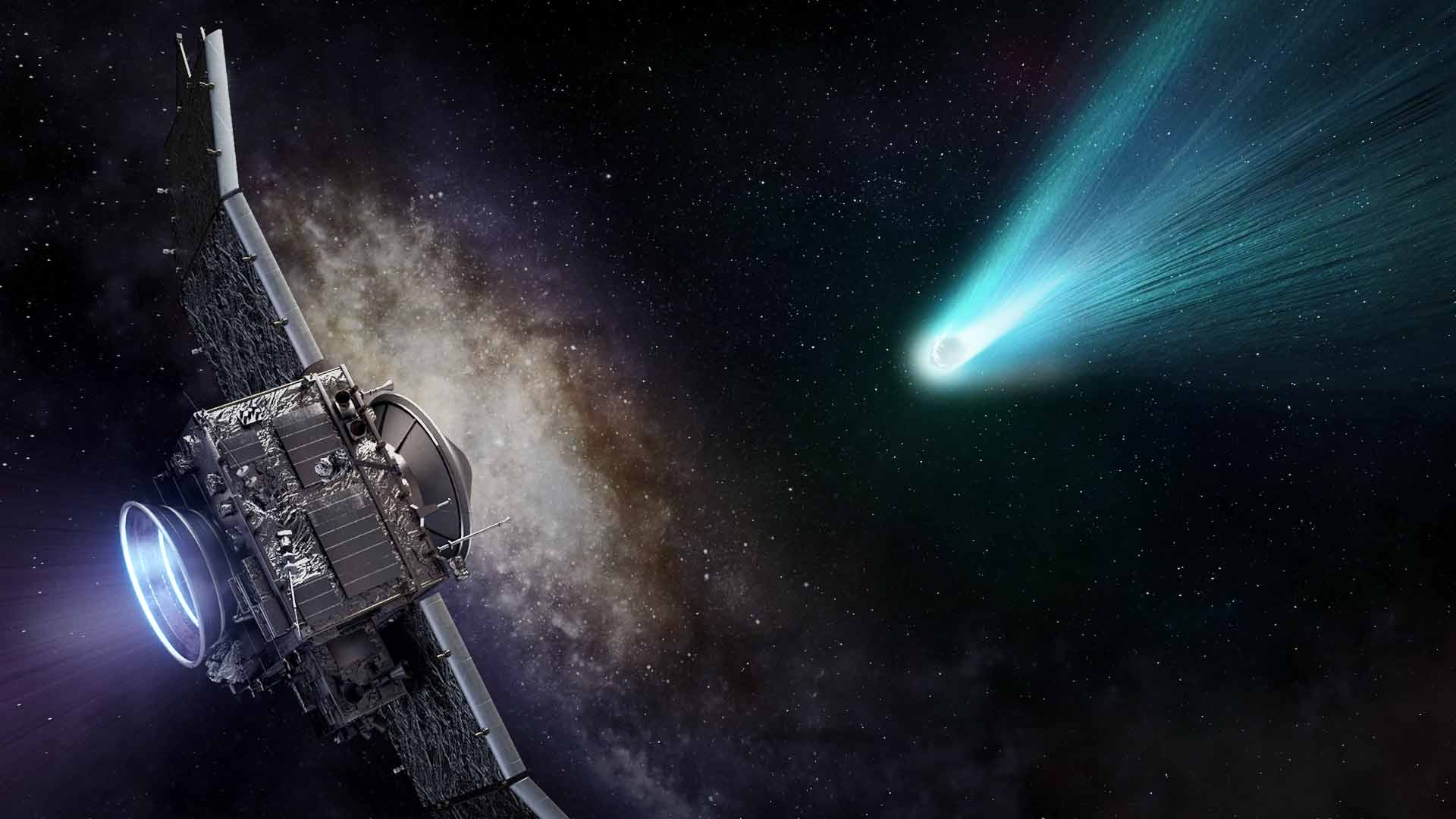
The interstellar object 3I/ATLAS is accelerating as it nears its closest approach to Earth, according to recent observations. Discovered in July by NASA’s ATLAS telescope in Chile, the comet has exhibited significant shifts in trajectory and speed since its closest approach to the Sun on October 29.
Scientists report that the object accelerated from over 130,000 mph to approximately 152,000 mph. This non-gravitational acceleration is attributed to gas releases caused by solar heating.
Harvard physicist Avi Loeb has posited that 3I/ATLAS could be an extraterrestrial mothership releasing small alien probes. In a statement, Loeb claimed: “If 3I/ATLAS is not enshrouded in a much more massive gas cloud after perihelion than it had in the months preceding perihelion, then its recent non-gravitational acceleration must have resulted from a different cause than cometary evaporation.”
However, NASA’s lead scientist for solar system small bodies, Tom Statler, has dismissed Loeb’s theory, stating: “It looks like a comet. It does comet things. It very, very strongly resembles, in just about every way, the comets that we know.”
The object is expected to make its closest approach to Earth on December 19, coming no closer than 170 million miles.