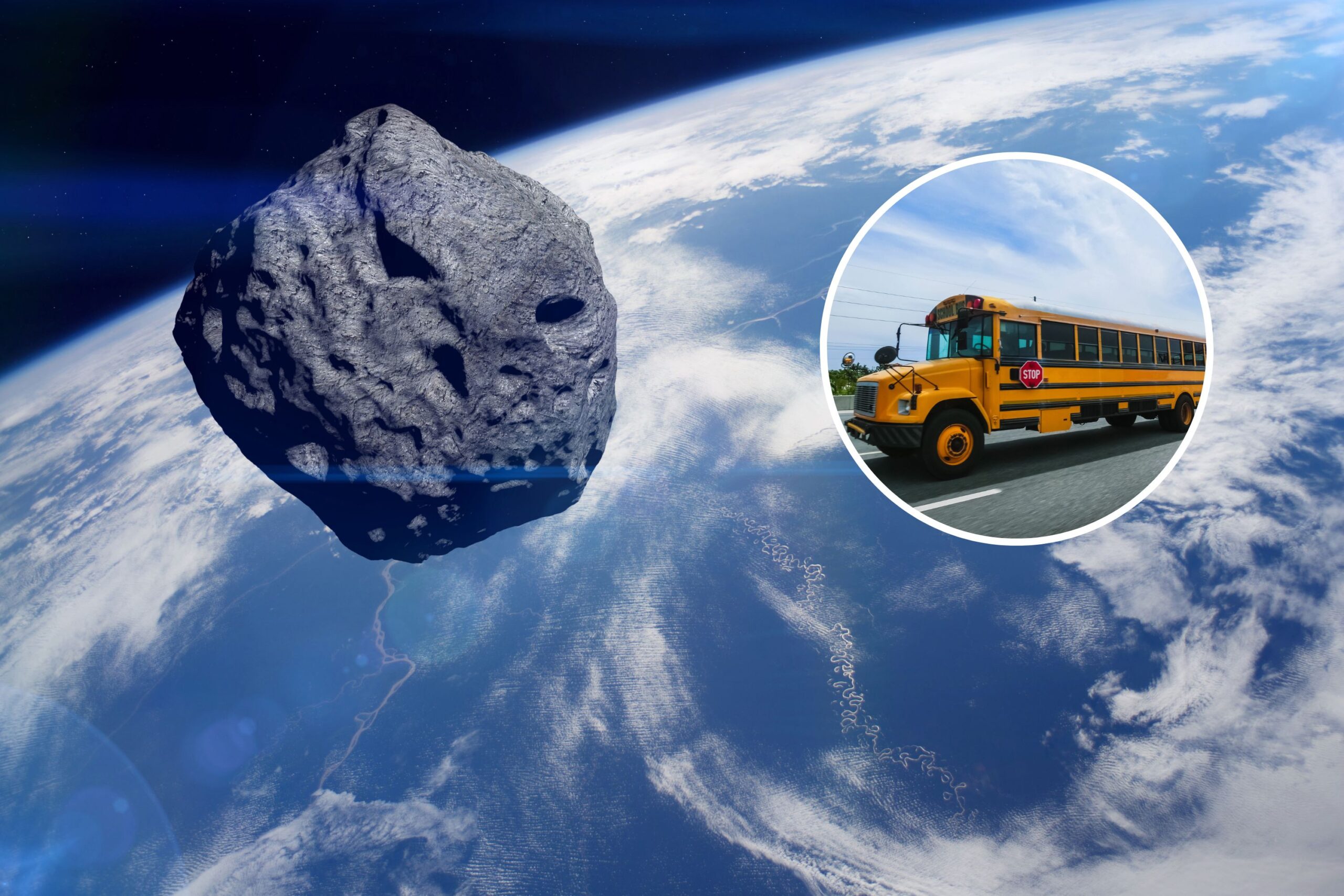
NASA has confirmed that none of the monitored asteroids pose a significant impact risk to Earth as they make close approaches this week.
A bus-sized asteroid named “2025 XF1” is expected to come within 195,000 miles of Earth on Saturday. According to NASA’s Center for Near Earth Object Studies (CNEOS) and Jet Propulsion Laboratory, the object—estimated at 41 feet in diameter—is traveling at nearly 8,000 miles per hour.
Additionally, a second bus-sized asteroid, “2025 XK1,” will pass within 624,000 miles of Earth on Friday. Two larger asteroids, “2020 WH20” and “2016 YH,” are also scheduled to make close passes near Earth on Friday and Saturday, respectively.
Paul Chodas, manager of CNEOS, clarified that the term “potentially hazardous” does not indicate an imminent threat. “The ‘potentially hazardous’ designation simply means over many centuries and millennia the asteroid’s orbit may evolve into one that has a chance of impacting Earth,” he stated.
NASA previously identified an asteroid, “2024 YR4,” with a 3.1 percent chance of impact in 2032—the highest probability recorded for an object of its size. However, further observations have ruled out significant risk for this asteroid.
Asteroids are rocky and metallic remnants from the formation of the solar system, primarily located in the asteroid belt between Mars and Jupiter. Near-Earth objects have orbits bringing them within 120 million miles of the sun, while potentially hazardous asteroids come within 4.6 million miles of Earth’s orbit.
Comets, though similar to asteroids, are composed of ice, dust, and small rocks that originate in the Kuiper belt or Oort Cloud. As comets approach the inner solar system, sunlight vaporizes their material, creating a visible “glowing” atmosphere.