New research from the Pew Research Center reveals that the long-term decline in U.S. religiosity has flattened since 2020, following decades of steady downward movement.
Gregory A. Smith, a senior researcher at Pew, described the recent pattern as “striking,” noting that previous surveys had consistently recorded declines across religious identity, practice, and belief. The stabilization is evident in several indicators of religious engagement, including prayer frequency, perceived importance of religion, and attendance at services.
Christianity remains the largest religious tradition among U.S. adults, claimed by 62 percent. Despite steep drops in religiosity over the past decade, about seven in ten Americans report belonging to a religious group.
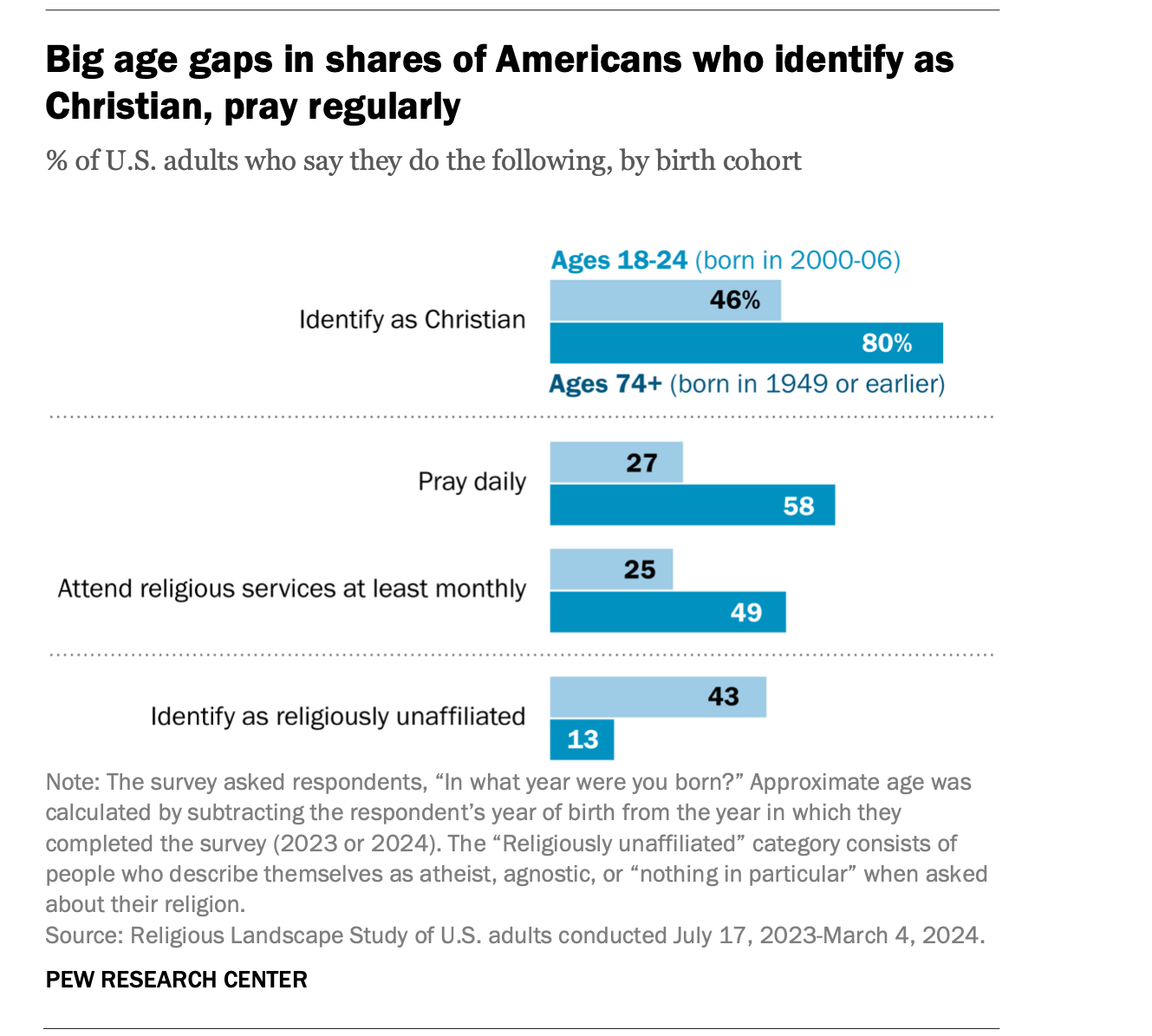
Generational contrasts are pronounced: 55 percent of adults aged 20 or younger identify as religious, compared with 83 percent among those 65 and older. Older adults are far more likely to pray daily (59 percent) than younger adults (30 percent).
Smith explained that young people often adopt the religious routines of their families but these habits may shift over time. “Historical data suggests the patterns we see today are a normal result of the youngest adults possibly following the religiousness of their parents for a few years past the age of 18, after which their religiousness begins to drop,” he said.
Conrad Hackett, a Pew demographer, emphasized that global trends in religious change do not follow a single pattern. “This secular transition isn’t completely uniform, and it may not be inevitable everywhere,” he stated. Researchers note that the current leveling off could persist but the future direction of U.S. religious affiliation remains uncertain.
The study also observed an increase in Christian enthusiasm among young men, particularly following events such as the assassination of Turning Point USA founder Charlie Kirk. Similar trends have been noted in Britain with young men flocking to the Roman Catholic Church.
Smith added: “Perhaps in the future we’ll look back and see that we were at a pivotal moment in 2025.”